 Raj
Raj 
So you can order food in Hindi, sing along to a Bollywood song, maybe even read Devanagari if you squint. 😅 But sit down to actually teach your 3-year-old her first words in the language. As someone who has been living abroad for decades, it’s most likely that you will freeze while actually teaching your native language to your child. What if you say it wrong? What if she grows up correcting your accent?
Stay calm. Here’s the thing: You don’t need fluency to raise a child who knows Hindi. You need a plan, 20 minutes a week, and permission to stop treating “not fluent enough” as a reason to not start at all.
First, a Quick Reality Check
Most diaspora parents assume language transmission requires a fluent teacher in the house. Trust me. It doesn’t.
Research on heritage language acquisition consistently shows that consistency and exposure matter more than parental fluency. A child who hears 10 Hindi words a day from an imperfect speaker will absorb more than a child who hears none from someone waiting to “get better first.”
And…Let’s be honest. The guilt around this is real. Many second-generation parents grew up being spoken to in Hindi and answering in English, which means their listening comprehension is strong but their speaking confidence never got built. That’s not a language failure. That’s just how bilingual households often work. You’re not starting from zero. You’re starting from “understands more than I think.”
Why Flashcards Work Better Than Trying to “Just Speak Hindi at Home”
Every parenting forum tells you the same thing – speak only Hindi at home. For most working parents juggling English-medium schools, English-speaking spouses, or simply English as the language they think fastest in, that advice collapses within a week.
Flashcards solve a different problem altogether. They don’t ask you to become fluent, they ask you to teach specific words, consistently, in short bursts. With flashcards, you’re not performing native fluency. You’re instead pointing at a picture of a hathi (elephant) and saying the word twice. Any parent can do that, regardless of their own comfort level.
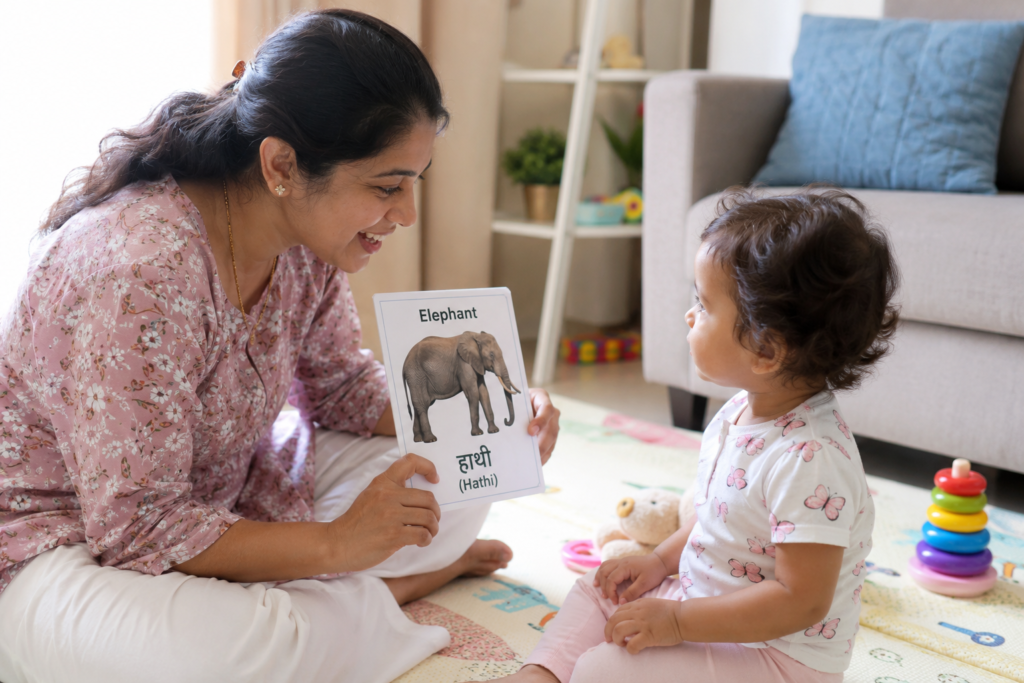
This also solves the pronunciation anxiety. When the word is printed with both Devanagari and a phonetic English spelling, you’re not conjuring up your Hindi memory anymore. You’re now reading it correctly together with the level of confidence you’ve always wanted!
Start With Categories, Not Grammar
Grammar can wait. Vocabulary can’t. This is because vocabulary is the foundation everything else sits on. The most effective starting point for toddlers and preschoolers is high-frequency, everyday categories:
- Family words: nana, nani, dada, dadi, bhai, behen
- Animals: billi, kutta, hathi, sher
- Colours and numbers: laal, neela, ek, do, teen
- Everyday objects: paani, khana, kitaab, ghar
A few days back, I showed my son, Anant a flashcard with a cat and asked him, “Can you say billi?” He looked at the card, smiled, and confidently replied, “Meow!” I and his mother couldn’t stop laughing. He didn’t know the Hindi word yet, but he had already connected the picture with the sound the animal makes. And…that’s how toddlers learn naturally. The more often they see and hear a word in context, the faster it becomes part of their vocabulary.
A Simple Weekly Structure That Actually Sticks
You don’t need a curriculum. You need a rhythm. Here’s one that works for busy parents:
- Pick 5 words on Sunday – One category, five words, printed or displayed somewhere visible, such as the fridge, their play mat or even their toy car.
- Say them out loud twice a day – Once in the morning and once before bed. Ten seconds each time.
- Let your child touch and point – Physical interaction with a flashcard builds recall far better than passive listening.
- Repeat the same five words all week – Resist the urge to add new words daily. Repetition is what moves a word from “recognized” to “recalled.”
- Review on next Sunday before starting new words – If your child hesitates on 2 out of 5, keep them for another week.
Sound simple? It is. The mistake most parents make isn’t lack of effort. It’s rotating vocabulary too fast, so nothing ever fully lands.
What to Do When Your Child Answers in English
This happens to almost every bilingual household, and it’s not a sign you’re failing. A child who understands Hindi but replies in English is still building receptive vocabulary, which is the harder skill and comes first. Expressive use (actually speaking it) typically lags behind by months, sometimes longer.
Don’t correct by demanding a redo in Hindi. Instead, repeat their sentence back with the Hindi word slotted in naturally. Like this – “Yes, that’s the billi! The cat is sleeping.”
Making Peace With Imperfect Hindi
Your accent doesn’t need to be like that of a newsreader app. Your grammar doesn’t need to be textbook-correct. What your child is absorbing isn’t a perfect linguistic model. It’s a relationship between a word, a sound, and a person they trust. And…that’s enough to build on. Formal grammar can come later, through school, apps, or tutors, once the ear is already trained.
The families who succeed at this aren’t the ones with the most fluent parent. They’re the ones who showed up with five words, most weeks, for a couple of years.
A Simple Way to Start This Week
If you want to skip the planning and just start, pick one category and commit to it for seven days. That’s the whole first step. There’s no need for a curriculum, no class, just one small set of words said out loud, twice a day, for a week. That’s it.
You might be interested in checking out – First 20 Hindi-English Words — Bilingual Flashcard Deck for Kids
That’s really it. You don’t need to speak Hindi like you grew up in Lucknow. You need to say five words a week, out loud, to someone who’s watching your mouth more closely than you think.