
 Raj
Raj 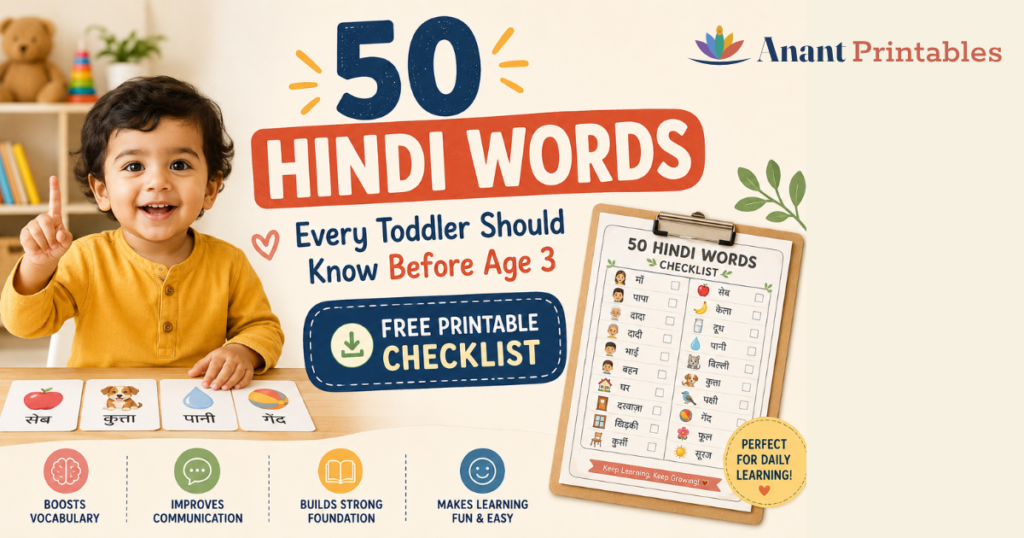
Somewhere between the first “mama” and the first full sentence, you start wondering if you’re doing this right. Is your toddler behind on Hindi? Ahead? Is there even a “right” list of words to aim for?
Hey! Don’t overthink. There isn’t an official list yet. No pediatrician hands you a Hindi vocabulary chart at the 2-year checkup of your toddler. But there is a practical one, built from how toddlers actually acquire language: Nouns first, everyday objects before abstract ideas, people before places.
In this blog post, I’m going to break down abstract Hindi vocabulary for toddlers into clearly defined categories that you can start using today!
First, What “Should Know” Actually Means Here
Let’s be honest about the word “should” in that title of this blog post. It’s doing a lot of work, and it can create needless pressure. Honestly, this isn’t a pass/fail benchmark. It’s just a reasonable target, the kind speech-language patterns suggest toddlers are developmentally ready for by age three, assuming regular exposure. If your child is at 15 words instead of 50, that’s not a red flag. It’s a starting line.
My own daughter, Ashi, knew only a handful of words when she was 2 years old – mostly words related to food and family! And here’s the funniest part: she knew only one color – red (laal). Whenever we asked her what color an orange was, she’d confidently say, “Laal.” What color is a banana? “Laal.” 😜
But children learn incredibly fast. Over time, her vocabulary blossomed, and by the time she turned 3, she could recognize and name all the major colors.
What matters more than the exact count is breadth across the categories. A toddler who knows five animals, five family words, and five colours is further along than one who knows twenty types of vehicles and nothing else. Breadth builds the scaffolding for sentences later.
The Checklist: 50 Hindi Words by Category
Print this, stick it on the fridge, and tick words off as your toddler recognizes or says them. Your toddler doesn’t need to learn all 50 words by age three. Treat it as a working target over the toddler years, not a deadline.
A. Family (6 words)
- Maa (Mother)
- Papa (Father)
- Nana (Maternal Grandfather)
- Nani (Maternal Grandmother)
- Dada (Grandfather)
- Dadi (Grandmother)
B. Animals (8 words)
- Billi (cat)
- Kutta (dog)
- Hathi (elephant)
- Sher (lion)
- Bandar (monkey)
- Machli (fish)
- Chidiya (bird)
- Gaay (cow)
C. Colours (5 words)
- Laal (red)
- Neela (blue)
- Peela (yellow)
- Hara (green)
- Kaala (black)
- Safed (white)
D. Numbers 1–10
- Ek
- Do
- Teen
- Chaar
- Paanch
- Chhah
- Saat
- Aath
- Nau
- Das
E. Everyday objects (6 words)
- Paani (water)
- Doodh (milk)
- Khana (food)
- Kitaab (book)
- Gaadi (car)
- Ghar (house)
F. Body parts (5 words)
- Sar (head)
- Haath (hand)
- Paanv (feet)
- Aankh (eye)
- Naak (nose)
G. Action words / feelings (9 words)
- Khush (happy)
- Gussa (angry)
- Rona (cry)
- Bhookh (hungry)
- Neend (sleepy)
- Chalo (let’s go)
- Ruko (stop)
- Padhna (study)
- Gaana (sing)
The most memorable words are always the ones tied to daily life, not the ones on a generic list.
Why This Order Matters
Notice the sequence isn’t random. Family and animals come first because they’re the words toddlers are already emotionally invested in. For example, a photo of ‘Nani’ gets more attention than a flashcard of an abstract shape. Numbers and colours come next because they map onto things toddlers are already sorting and counting in English, so the Hindi word slots into a concept that already exists.
You might be interested in reading – How to Teach Your Child Hindi at Home When You Don’t Speak It Fluently!
How to Actually Use This List (Not Just Print It)
A checklist taped to the fridge and never touched again doesn’t teach anyone anything. Here’s a rhythm that works with the categories above:
- Don’t pick the whole list all at once. Instead, pick one category per week and stick to it for that week. Five to six words is the ceiling for meaningful repetition in a week.
- Say the word in context, not isolation. For example, instead of just saying “billi,” try “dekho, billi so rahi hai” (look, the cat is sleeping). Context roughly doubles retention compared to naming objects in isolation.
- Revisit old categories every third week. Toddler memory needs spaced repetition
- Mark the checklist honestly. A tick mark for “recognizes but doesn’t say” is useful information as it tells you which words are close to becoming your toddler’s expressive vocabulary.
What If Your Toddler Isn’t Hitting These Numbers?
Let’s be honest: Vocabulary acquisition in a second or heritage language is uneven, and it’s shaped entirely by exposure window, not just innate ability of the toddler. A toddler getting Hindi input for twenty minutes a day will simply move slower than one hearing it for three hours a day. If your child is behind this list, the fix isn’t more pressure. It’s all about being more consistent, even with low-stakes exposure. Five words repeated daily beats fifty words shown all at once.
Download and Print
This checklist is most effective when it’s out in the open, not hidden away in your phone’s photo gallery / notes app. Click here to download PDF version of this 50-word checklist for FREE! Print it, stick it on your fridge, your child’s study area, or anywhere you’ll see it every day. If you’d like it to last, laminate it and use a dry-erase marker to check off each week’s progress.
If you want the words paired with actual flashcard images instead of a text checklist, that’s exactly what a structured flashcard set solves – First 20 Hindi-English Words (Bilingual Flashcard Deck for Kids
Fifty words feels like a lot written out in one list. Spread across a year, in five-word batches, it’s just Tuesdays and Thursdays before bed.