 Raj
Your four-year-old can spot a circle from across the room but calls a rectangle “a long square.” Or knows “triangle” perfectly and then confidently points at a diamond and says it too. Somewhere in there is a gap between recognising a shape and actually understanding what makes it that shape.
A chart on the wall fixes more of this than you’d expect. Not because kids learn by staring at posters, but because it gives you something to point at a dozen times a week without having to set up an activity every time.
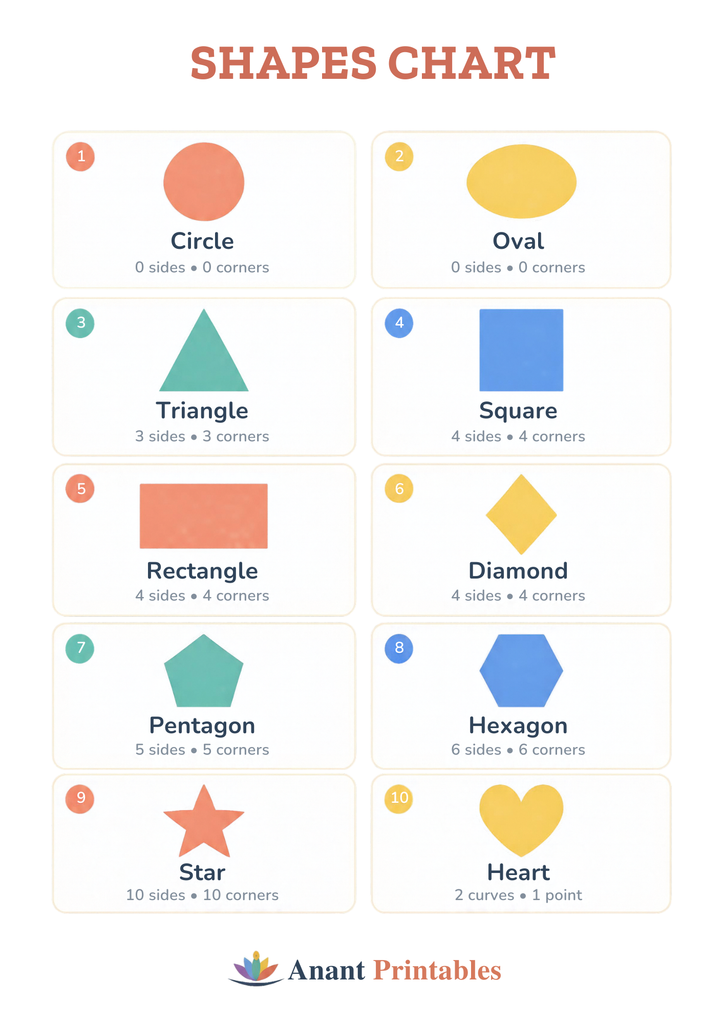
Well, without further ado – here’s the chart showing each shape and the order I’d teach them in.
Click here to download the free printable shapes chart PDF
First, a quick reality check about shape charts
A chart by itself teaches almost nothing. Stick it on the fridge, never mention it again, and in three months your child will know exactly as many shapes as they did on day one.
What the chart actually does is lower the effort for you. When it’s visible, you’ll naturally say “look, that biscuit is a circle” five times a week instead of twice a month. That repetition is the thing doing the teaching. The chart is just what makes the repetition happen without planning.
So print it, but put it somewhere you’ll both see it daily, for example – next to the dining table, beside the play mat, on the fridge at their eye level, not yours.
The shapes chart: names, sides, and corners
Ten shapes, with what makes each one different. This is the part most charts skip, as they show the shape and the name and stop there, which is why kids end up calling a rectangle a long square.
| Shape | Sides | Corners | Why it’s different |
|---|---|---|---|
| Circle | 0 | 0 | Perfectly round all the way, no straight bits |
| Oval | 0 | 0 | Round like a circle, but stretched longer one way |
| Triangle | 3 | 3 | The fewest sides a shape can have |
| Square | 4 | 4 | All four sides exactly the same length |
| Rectangle | 4 | 4 | Four sides, but two long and two short |
| Diamond | 4 | 4 | A square tipped onto its corner |
| Pentagon | 5 | 5 | One more side than a square |
| Hexagon | 6 | 6 | Six sides, like a honeycomb cell |
| Star | 10 | 10 | Points that go out, then in, then out again |
| Heart | 2 curves | 1 | Two curves on top, one point at the bottom |
Here’s how to read this properly: the “sides and corners” columns aren’t trivia to memorise. They’re the language your child needs to tell shapes apart. A kid who knows a square has four equal sides has a reason why a rectangle isn’t one. A kid who only knows what a square looks like is guessing.
I realised this firsthand with my daughter. She used to get confused between a diamond and a square because she was learning shapes mostly by their appearance. One day, she pointed at a square that I had tilted and said, “Papa, look! If we tilt this page, this square becomes a diamond.” She wasn’t really wrong as she was using what she could see to make sense of the shape. That moment made me realise that simply asking children to recognise shapes by sight isn’t always enough.
I started explaining shapes using their properties, i.e., how many sides and corners they have, and whether those sides are equal. Once she understood that a square has four equal sides and four corners, she began to recognise a square regardless of how it was rotated. That experience is why I believe a good shape chart for preschoolers should teach children how to identify a shape, not just memorise what it looks like.
Teach them in this order, not alphabetically
Most charts list shapes in no particular order, which quietly suggests you should teach them that way. Please stop. There’s a sequence that works much better, and it follows how hard each shape is to actually draw.
- Circle — one continuous motion, no corners to plan ahead for
- Square — four straight lines, all the same, highly predictable
- Triangle — straight lines but now with angles that have to meet
- Rectangle — introduces the idea that sides can differ in length
- Oval, diamond, star, heart — the “fun” shapes, recognisable long before they’re drawable
- Pentagon and hexagon — save these for last; they’re counting exercises as much as shape exercises
Starting with circle and square isn’t arbitrary. They’re the two shapes a three-year-old’s hand can actually produce, which means early wins instead of early frustration. Pentagon first would be a bad week for everyone.
Four games that make the chart earn its place
I would like to say this bluntly –
A chart you only look at is a poster. But, a chart you play with is a teaching tool.
Here are four fun games that you can play with your children to help them learn shapes through practical means, rather than by theory alone. The best part is – these games take no setup and work with whatever’s already there in the house.
- Shape hunt: Pick one shape from the chart. Send your child to find three things in the house that match it. For example, if you say circle, they should go and hunt for plates, clocks, bottle caps, etc.
- Shape sort: Dump a mixed pile of objects on the floor and sort them into groups by shape, chart in hand as the reference. This is the single best activity on this list, because sorting forces a decision about each object rather than passive naming.
- Sides and corners count: Point at a shape on the chart and count its corners out loud together, touching each one. Pairs shape learning with early counting, and it’s the fastest way to kill the square-versus-rectangle confusion.
- What am I? You describe, they guess: “I have three sides and three corners.” Then swap – let them describe and you guess, including getting it wrong occasionally so they can correct you. Kids love this far more than the difficulty warrants.
For us, the shape hunt worked the best. My daughter loved being sent around the house on a little mission to find circles, squares and triangles. At first, she needed a lot of help, but after playing a few times, she started spotting shapes on her own. I remember her pointing at a plate and saying, “Papa, this is a circle!” without me asking her. That was when I realised she wasn’t just memorising the pictures on the chart anymore…she was beginning to connect the shapes with the world around her!
When a chart stops being enough
At some point your child will name every shape on the chart confidently…and then struggle to draw a single one. That’s not a step backwards. Recognition and production are two different skills, and recognition always arrives first.
That’s the moment the chart has done its job and the next thing has to take over: tracing the outline, counting the sides as they draw, then trying it freehand without a guide. Recognising a hexagon and drawing one are separated by a lot of fine motor practice.
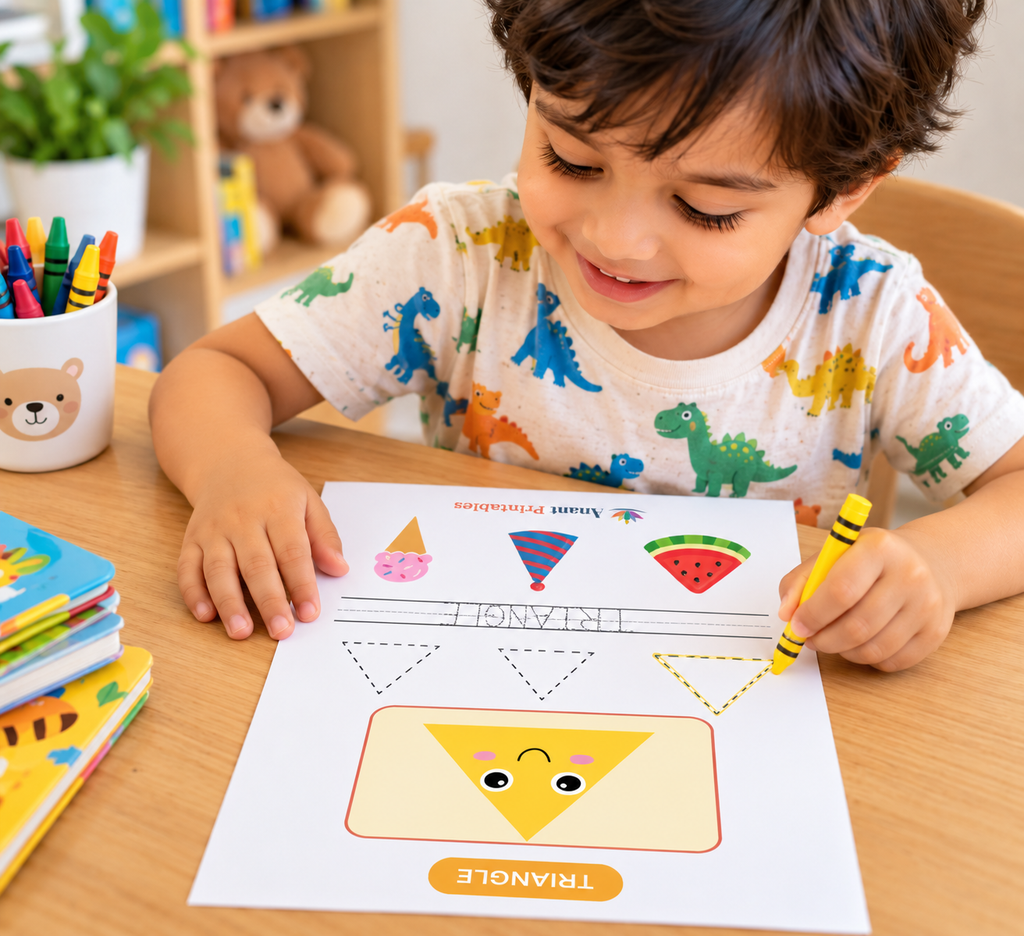
Therefore, once your child can confidently recognise the shapes, the next challenge is getting those hands to draw them. This is where we found tracing activities particularly useful. Our Shape Worksheets for Preschoolers were created with this transition in mind, combining shape outlines to trace with real-world objects to identify and match. Children can also practise tracing the name of each shape, turning one simple activity into a little practice in both shapes and early writing.
Print the shapes chart and put it somewhere annoying
Not literally annoying. But somewhere you can’t avoid seeing it, which is the same thing in practice. The fridge door, the back of the bathroom door, beside the dining table.
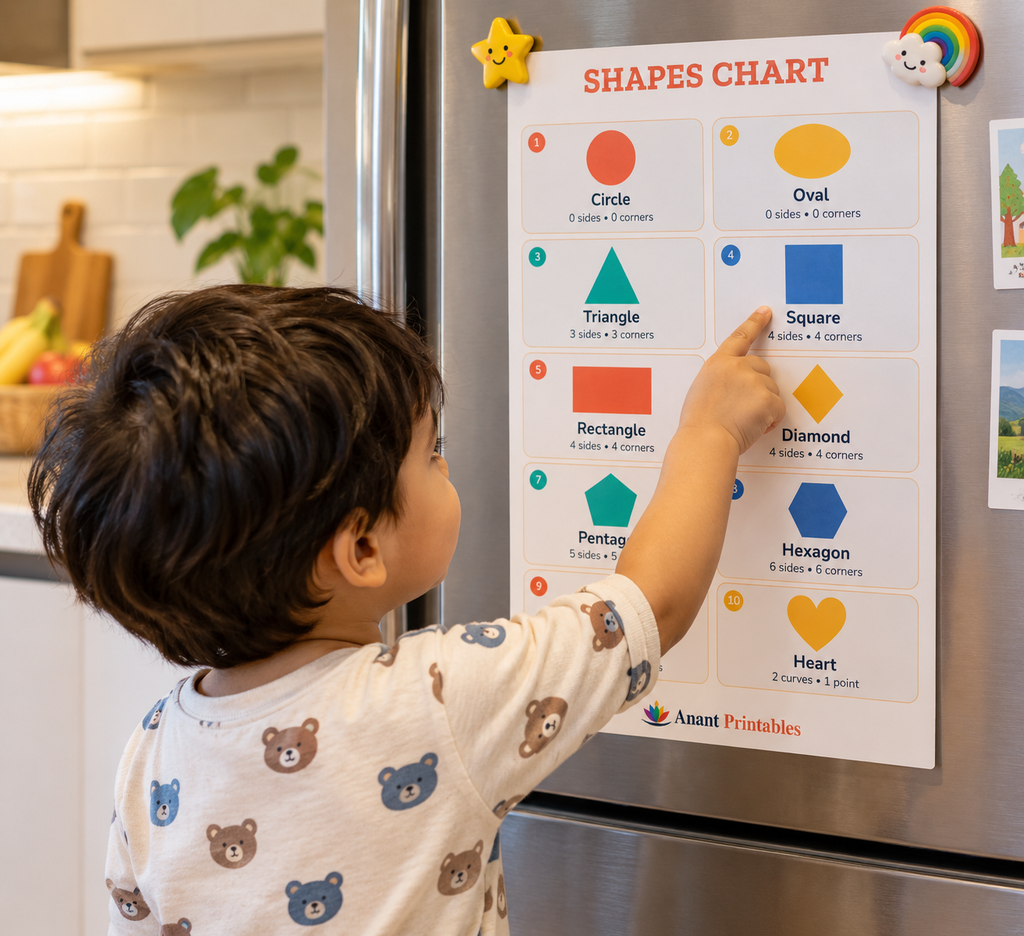
The parents who get the most out of a shapes chart aren’t the ones who schedule shape lessons. They’re the ones who walk past it four times a day and say “hey, what shape is that one?” without thinking about it.
So which shape did your child recognise first and which one took the longest to click? In our case, diamond and square caused a fair bit of confusion at first, especially when the square was tilted. I’d love to know what it’s been like in your home. Did your child have a shape they picked up almost immediately? Was there one they kept mixing up with another? And has anything you tried made that tricky shape finally “click”?