 Raj
Raj 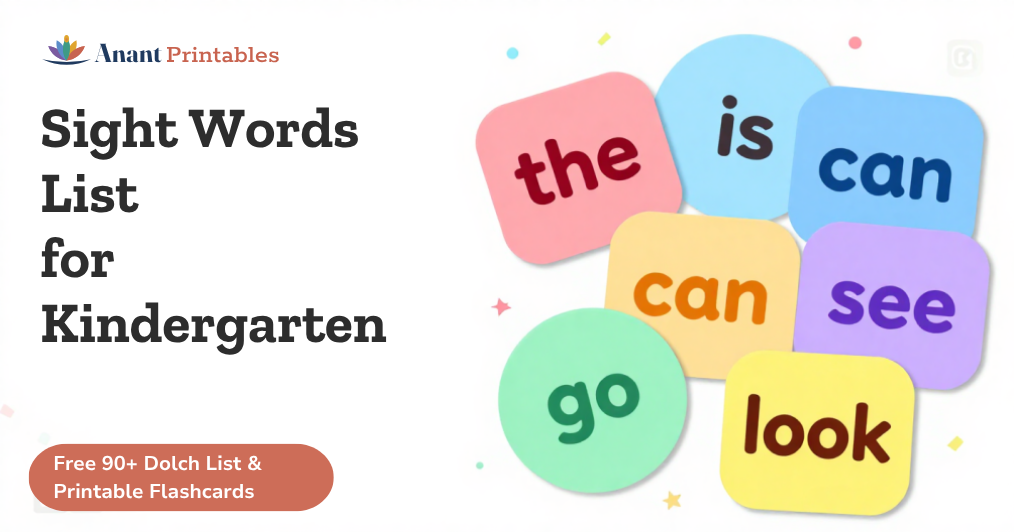
You’ve probably heard the term “sight words” a dozen times since your child started kindergarten. May be you saw this on the school newsletter, from the teacher at pickup, or maybe you found it scribbled on a homework sheet you’re supposed to practice at home. But what actually counts as a kindergarten sight word? Is there an official list? And what’s the fastest way to actually teach them, beyond just staring at flashcards together and hoping something sticks?
Here’s the full list, why it matters, and a practice method that works better than just reading words off a page.
First – What Are Sight Words, Really?
Sight words are the words kids need to recognize instantly, on sight, without sounding them out. Words like the, was, and said don’t follow reliable phonics rules. A 5-year-old sounding out “s-a-i-d” phonetically would land on “sayed,” not “said.” So instead of decoding, kids memorize these words by sight, through repetition.
The most widely used sight word list is the Dolch list, developed by educator Edward Dolch in the 1930s and 40s. He studied children’s books of the era and pulled out the words that showed up over and over – the ones that make up roughly 75-80% of the words in a typical early reader. Once a child has these memorized, sounding out the remaining, less common words gets a lot easier, because they’re not stopping on every third word.
The Free Kindergarten Sight Words List (PDF)
Following is the standard Dolch Kindergarten list – 52 words, public and free to use for practice at home or in the classroom:
| ALL | AM | ARE | AT |
| ATE | BE | BLACK | BROWN |
| BUT | CAME | DID | DO |
| EAT | FOUR | GET | GOOD |
| HAVE | HE | INTO | LIKE |
| MUST | NEW | NO | NOW |
| ON | OUR | OUT | PLEASE |
| RAN | RIDE | SAW | SAY |
| SHE | SO | SOON | THAT |
| THERE | THIS | TOO | UNDER |
| WANT | WAS | WELL | WENT |
| WHAT | WHITE | WHO | WILL |
| WITH | YES |
Click here to download the above list in PDF format (FREE)
Many kindergarten classrooms also fold in words from the Dolch Pre-K list (40 words), since a lot of five-year-olds are working through both simultaneously:
| A | AND | AWAY | BIG |
| BLUE | CAN | COME | DOWN |
| FIND | FOR | FUNNY | GO |
| HELP | HERE | I | IN |
| IS | IT | JUMP | LITTLE |
| LOOK | MAKE | ME | MY |
| NOT | ONE | PLAY | RED |
| SAID | SEE | THE | THREE |
| TO | TWO | UP | WE |
| WHERE | YELLOW | YOU | US |
Click here to download the above list in PDF format (FREE)
That’s over 90 words combined, which sounds overwhelming written out in one block like this. It isn’t, in practice, if you don’t try to tackle it all at once. More on that below 🙂
Why Flashcards Work Better Than a Printed List
A list like the one above is useful as a reference. But it’s not actually how kids learn the words. Reading a word passively off a page, over and over, produces weaker recall than active retrieval, i.e., seeing a card, being asked “what’s this word?”, and having to produce the answer yourself. That small effort of retrieval is what moves a word from “recognized if I stare at it” to “known instantly.”
This is exactly how my daughter, Ashvika, learned her sight words. I found that showing her pictures alongside the words helped her build an instant, meaningful connection. For example, I would hold up a flashcard featuring a big red apple and ask, ‘Hey Ashvika, what color is this apple?’ Because it was such a familiar fruit, she immediately associated the word ‘red’ with the image. We used the same approach for other concepts, too….I’d show her a picture of an ant and ask, ‘Is it tiny or big?’ to give the words real-world context.
This is also where picture and sentence context earn their keep. A card that shows just the word “see” asks a child to memorize an abstract shape – it’s just a waste of time and efforts! A card that shows the word “see,” a small illustration, and the sentence “I can see the butterfly” gives the brain three anchors instead of one – the word, an image, and its use in a real sentence. Kids who are still building vocabulary alongside sight-reading skills lean on that context more than adults might expect.
A Practice Routine That Actually Works In Learning Sight Words
Flashcards fail most often not because of the cards themselves, but because of how they’re used. Dumping 50 words in front of a 5-year-old at once is a recipe for frustration, not learning. Here’s a rhythm that holds up better:
- Work in batches of 5 to 8 words, not the whole list all at once. Small, focused batches are what actually get retained.
- Practice for 5 minutes, not 20. Short and frequent beats long and occasional practice. Sight word recall is built through spaced repetition, not marathon sessions.
- Shuffle in 1 to 2 “known” words with new ones. A quick and easy win keeps a 5-year-old motivated and engaged.
- Retire words once they’re instant and rotate in new ones from the batch behind them.
- Revisit “retired” words every couple of weeks. Kids do forget words they’ve technically mastered if there’s zero follow-up.
Do You Need to Make Your Own Flashcards?
You can, and plenty of parents do! Index cards and a marker work fine for a rainy afternoon project. But if you’d rather skip the cutting, drawing, coloring, and hand-drawing part, that’s exactly the gap a ready-made deck fills.
Our Kindergarten Sight Words Flashcards deck covers 20 of the most commonly taught kindergarten-level sight words, including several from the list above, like ‘see’, ‘little’, ‘help’, ‘good’, and ‘under’ – each card already paired with a simple illustration and an example sentence, sized to print directly onto a cute 3×5″ cardstock.
If you’re working through the full 90-word combined list, think of it as a starting deck: The words most kindergarten teachers introduce first, already print-ready, so you can spend your practice time actually practicing instead of prepping.
Frequently Asked Questions
Most kindergarten curricula target somewhere between 25 and 50 sight words by year’s end, though this varies by school and program. The Dolch Kindergarten list of 52 words is a reasonable full-year target, not a starting point.
Phonics teaches kids to sound out words using letter-sound rules. Sight words are an exception. These are common words that don’t follow those rules reliably enough to sound out, so they’re memorized by repetition instead. Strong early readers need both.
No. Flashcards build word recognition, which is one piece of learning to read. They work best alongside phonics instruction and actual reading practice, not as a replacement for either.
I know. 92 words are a lot on paper. Five words a week, for five minutes a day, is the perfect recipe for your child to master these sight words.
What’s the sight word that’s tripping up your little reader right now? Drop it in the comments below. I’ll bet a few other parents are stuck on the exact same one. Let’s find out 🙂